|
|
 |
Baked Eggnog Cheesecake—Prototype 34:
Crust:
4 oz. melted, white chocolate
8 oz. (about 1 cup) whipped, lowfat cottage cheese
1/4 cup granulated sugar
1 tablespoon brown sugar
1 teaspoon cinnamon
1/2 teaspoon vanilla
3 oz. graham crackers, ground up (if these are cinnamon-flavored, omit the cinnamon shown above)
Place the resulting mixture into a greased 13" x 9" glass
("Pyrex") pan and pre-bake without tub at 300 degrees for 30
minutes, then remove from oven and cool down at room temperature (for at
least 30 minutes).
Batter:
16 oz. (about 2 cups) whipped, lowfat cottage cheese
8 oz. softened Neufchatel cheese ("light cream cheese")
3/4 cup granulated sugar
1 teaspoon vanilla
1/2 teaspoon rum extract
1/2 teaspoon nutmeg
2 cups light eggnog (such as Hood)
3/4 teaspoon xanthan gum
3 eggs
Original Baking Procedure:
Expect close to 6 cups of the resulting batter, but do not add this to
the pan all at once. Rather, this needs to be done in four
installments.
For each of the first three installments, gently scoop about 1 1/2 cups of
batter into the pan, fully covering the surface (here's a tip—scoop small
amounts of batter into scattered places throughout the pan, letting this batter
fill in nearby gaps, and if any of these remain, use a rubber spatula and
gently spread the batter to cover these gaps up), and then bake this pan with
its contents for 25 minutes, at 325 degrees. However, at the end of the third
installment's 25 minutes, add on another 5 minutes of baking time, but only at
300 degrees (that's a 30 minute "baking installment"—the first
25 minutes at 325 degrees and the next 5 at 300). For all four installments,
bake with the pan in a tub filled with at least 1/4 to 1/2 inch of boiling
water.
After the first three installments are done, there should be about 1 1/2 cups of
batter left, with 80 minutes of baking time reached at this point (25 minutes
for each of the first two installments, and 30 for the third one). Now comes the
fourth installment—carefully add the last of this batter on top of the
pan's earlier installments, fully coating the entire surface. Next, return the
entire pan-and-tub assembly to the oven, with the temperature remaining at 300
degrees. Resume baking for another 30 minutes.
Afterward, shut the oven off, and leave its door slightly ajar, with the
cheesecake still inside—and in the tub—for an hour. Next, remove the
cheesecake from the oven and tub. Continue to cool it down at room temperature
for another 120 minutes, then (with cheesecake still in pan) refrigerate.
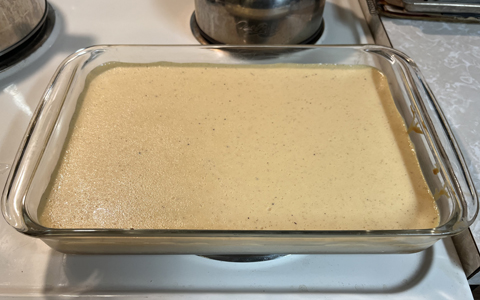
New December 2025 Baking Procedure:
Expect close to 6 cups of the resulting batter, but do not add this to
the pan all at once. Rather, this needs to be done in four installments.
Wrap the pan in foil (or—as an alternative—use a cheesecake pan
bath wrap) just before adding the first batter installment (to minimize the
foil's disturbance and therefore its leakage risk, do not put it on any
earlier).
For each of these four installments, gently scoop about 1 1/2 cups of batter
into the pan, fully covering the surface (here's a tip—scoop small
amounts of batter into scattered places throughout the pan, letting this batter
fill in nearby gaps, and if any of these remain, use a rubber spatula and
gently spread the batter to cover these gaps up), and then bake this pan with
its contents for 25 minutes—at 325 degrees for the first two installments,
and at 300 degrees for the remaining two. For the first three installments, bake
with the pan in a tub filled with at least 1/4 to 1/2 inch of boiling water, but
(to reduce spillage risks) do not fill the tub all the way at this point,
because the whole tub-and-pan assembly is going to need to be removed from the
oven (in order to comfortably add contents to the pan) between installments.
However, fill up the tub generously with boiling water just before the final
baking installment.
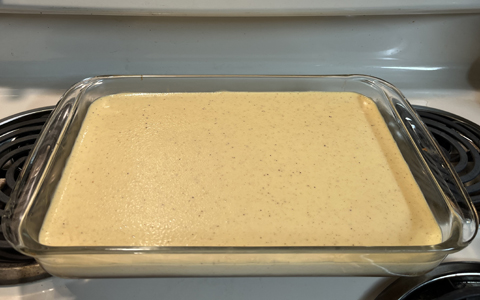
Afterward, shut the oven off, and leave its door slightly ajar, with the
cheesecake still inside—and in the tub—for an hour. Next, remove the
cheesecake from the oven and tub. Continue to cool it down at room temperature
for another two hours. After doing so, remove the cheesecake from pan and
refrigerate.
|
|

|